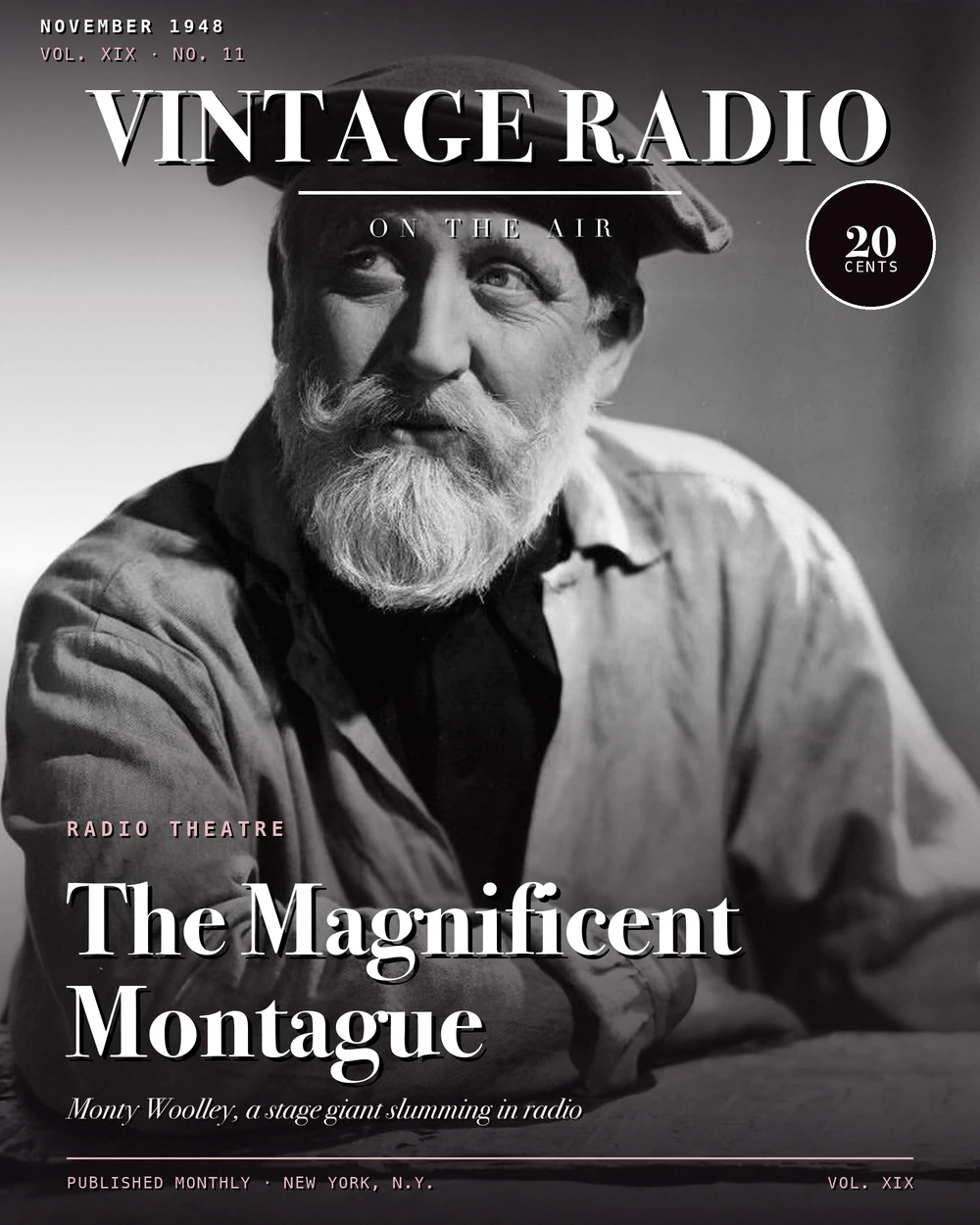
The Magnificent Montague
The Joke at the Center of It All
The Magnificent Montague ran on NBC for exactly one year — from November 10, 1950 to November 10, 1951 — and its central premise was as clean as premises get. Edwin "the Magnificent" Montague, a former Shakespearean actor of genuine stature, has been reduced by circumstance to playing a character called Uncle Goodheart on a radio program. He considers this an unspeakable humiliation. His entire comic mission, week after week, is to keep his fellow members of the exclusive Proscenium Club from finding out what he's been doing to pay the bills.
What sharpened the joke considerably was that Montague's wife, Lily, had helped him land the radio role in the first place. She did him a favor. He is insufferably ungrateful about it. That asymmetry between Lily's practical good sense and Montague's theatrical self-regard gave the show a reliable engine of comic tension, and the casting of Monty Woolley in the lead made the whole thing click. Woolley had privately despised radio throughout his career, which meant his portrayal of a man who considered radio beneath him wasn't much of a stretch at all.
The supporting cast filled out the household and its edges. Anne Seymour played Lily with the patience of a woman who had long since taken the full measure of her husband. Pert Kelton played Agnes, a Brooklyn-accented maid who lived in the Montagues' New York apartment and delighted in verbal jousting with her employer. Art Carney played Montague's father, John Gibson played his agent, and Jack Ward provided the organ music. Hans Conried turned up in the supporting cast as well. The whole operation was written and produced by Nat Hiken.
Monty Woolley and the Beard
Monty Woolley was not a conventional radio leading man, and that was the point. Born Edgar Montillion Woolley on August 17, 1888, in Manhattan — his father owned the Bristol Hotel on Broadway — he took an entirely different road to performance than most of his contemporaries. He earned a bachelor's degree from Yale, then master's degrees from both Yale and Harvard. Cole Porter was his intimate friend and classmate at Yale. He became president of the Yale Dramatic Association, then returned to Yale as an assistant professor of English and drama coach, where Thornton Wilder and Stephen Vincent Benét were among his students. He served in World War I as a first lieutenant on the U.S. Army general staff in Paris.
Broadway directing came next, starting with Fifty Million Frenchmen in 1929. Then, in 1936, he left academia and began acting professionally on stage. His signature role arrived in 1939, when he played Sheridan Whiteside in Kaufman and Hart's The Man Who Came to Dinner for 783 Broadway performances — a character written as a caricature of pundit Alexander Woollcott. He reprised the role in the 1942 film. The Academy nominated him for Best Actor in 1943 for The Pied Piper and for Best Supporting Actor in 1945 for Since You Went Away.
His trademark was a large white beard, which he valued at $8,000 — a figure he apparently stated to Paramount Pictures when they wanted him for a film and asked him to shave it. He refused. Paramount passed. He kept the beard. He was known in the industry affectionately as "The Beard," and in 1943 he had his hands and beard immortalized in the pavement at Grauman's Chinese Theatre. Before The Magnificent Montague, he had appeared as an acid-tongued foil for Al Jolson and made his way through guest spots on The Fred Allen Show, Duffy's Tavern, The Big Show, and The Chase and Sanborn Hour. He was not exactly new to radio. He simply thought very little of it.
The Team Behind It
Nat Hiken — born Nathan Hiken in Chicago on June 23, 1914 — had learned his craft writing for Fred Allen's program, eventually rising to head writer before leaving in 1947 to work independently. The Magnificent Montague was his first sustained experiment with recurring characters in a half-hour sitcom format. He was both producer and writer on the show, which meant the voice was consistent from week to week.
The year The Magnificent Montague launched, Hiken's name had appeared in Red Channels, the 1950 publication that listed suspected Communist sympathizers in the entertainment industry. The listing was attributed to his mother's political views. Hiken responded by taking out an advertisement in Variety denying any Communist beliefs, and the threat subsided. He kept working.
What he built with Montague was a character-driven comedy that one later critic described as having "a Frasier Crane quality" in Woolley's hands — a show "hinged around a unique persona within an inherently funny and conflict-laden situation." The same observer noted that the supporting characters lacked sufficient depth to sustain the series beyond a single year, which is a fair reading of why the show didn't continue. The central performance was strong. The infrastructure around it was thinner.
After The Magnificent Montague, Hiken went on to create The Phil Silvers Show (1955–1959) and Car 54, Where Are You? (1961–1963), winning eight Emmy Awards along the way. He is credited with giving Fred Gwynne, Alan Alda, and Dick Van Dyke their early television opportunities through The Phil Silvers Show. His scripts and production materials for The Magnificent Montague, filed alongside materials for The Fred Allen Show and The Milton Berle Show, are held in the Nat Hiken Papers (1932–1968) at the Wisconsin Center for Film and Theater Research. David Everitt's book King of the Half Hour: Nat Hiken and the Golden Age of TV Comedy, published by Syracuse University Press in 2001, documents his career in full.
A Cast Worth Knowing
The supporting players brought considerable resumes of their own. Anne Seymour — born Anne Eckert on September 11, 1909, in New York City — came from seven generations of a theatrical family traceable to Ireland in 1740. Her great-uncle was character actor Harry Davenport, and her brother James Seymour co-wrote 42nd Street in 1933. She had spent eleven years, from 1934 through 1945, playing the lead in the radio soap opera The Story of Mary Marlin, whose theme was Debussy's "Clair de Lune." She had also appeared on Grand Hotel and A Woman of America before taking on Lily Montague.
Pert Kelton, born October 14, 1907, in Great Falls, Montana, had been performing since age three — her parents were both vaudeville performers, and her stage debut happened in Cape Town, South Africa. By age 12 she was doing vaudeville as a solo act; by 17 she had made her Broadway debut in Jerome Kern's 1925 musical Sunny. She appeared in roughly 30 Hollywood films between 1929 and 1939, then redirected toward theater and radio. Before joining The Magnificent Montague, she had played five different characters on The Milton Berle Show in 1949 and was a regular on The Henry Morgan Show. Her name, along with her husband, actor-director Ralph Bell, had also appeared in Red Channels in 1950.
Kelton was, at exactly this same moment, the original Alice Kramden in the Honeymooners comedy sketches on DuMont Television's Cavalcade of Stars. She would later be replaced in that role — her departure attributed publicly to "heart problems" — in the wake of the blacklist. She eventually became best known for creating the role of Mrs. Paroo in the original 1957 Broadway production of The Music Man, which she reprised in the 1962 film. She received Tony nominations for Greenwillow in 1960 and Spofford in 1968, and died on October 30, 1968.
Art Carney, born Arthur William Matthew Carney on November 4, 1918, in Mount Vernon, New York, had spent the 1940s doing character work and celebrity impressions on radio — including Franklin D. Roosevelt and Winston Churchill. In 1950, just as The Magnificent Montague was beginning, he was also beginning his work with Jackie Gleason on Cavalcade of Stars, where he would soon develop Ed Norton alongside the same Pert Kelton playing Alice Kramden. The coincidence is notable: Carney and Kelton were cast together on both programs at essentially the same time. The announcer for The Magnificent Montague was Don Pardo, then a staff announcer at NBC, who would go on to a decades-long run as the voice of Saturday Night Live.
One Year on NBC
The Magnificent Montague aired on Fridays at 9 PM until May 1951, then moved to Saturdays at 8:30 PM, and in its final month shifted to 8 PM on Saturdays. Sponsors over the run included Anacin, Chesterfield, and RCA. The show ran thirty-minute episodes for its full year, producing roughly 52 episodes in total.
The surviving episodes give a reasonable picture of what the series did week to week. Titles like "To Play Romeo," "Movie Offer," "Lost in Hollywood," and "Screen Test" show the writers working the tension between Montague's theatrical ambitions and the commercial reality of radio and film work. "To Shave Or Not To Shave" put the beard — his defining feature — directly into play. "Shakespeare in the Park" sent him to perform for the "Cultural Division of the Brooklyn Academy of Fine Arts," with the comedy landing when he ends up at Ebbets Field instead. "Agnes Quits" and "Montague's Surprise Birthday Party" kept the domestic machinery running. An episode from February 2, 1951, "Sharing Bungalow," centers on Montague growing increasingly hostile toward Hollywood during a stay out west.
The show did not return for a second season, and Hiken moved on to television, where the scale of his success with The Phil Silvers Show and Car 54 eventually overshadowed this earlier experiment. The Magnificent Montague stands as the proof of concept — the place where Hiken first worked out what he could do with a strong central character, a confined domestic setting, and a premise that generated conflict automatically just by putting the lead in the room.